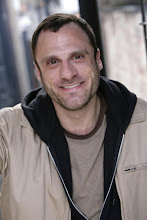
Scott and I are making the rounds of seeing all the Oscar contenders for this year. Yesterday we saw Michael Clayton. So I've now seen four of the five films nominated for Best Picture. I still have yet to see There Will Be Blood, which Scott saw on his own with a friend, so he's one up on me. I'm looking forward to seeing Daniel Day Lewis' critically acclaimed performance, although I am not looking forward to sitting in a movie theatre for three hours. But that's a rant for another post.
This post's rant is on the "brilliance" of No Country for Old Men. I did not enjoy this film. I can appreciate the fine performances of the actors, I can appreciate the direction and cinematography. But this film left me totally flat. First, there was the violence. I have a problem with a lot of gratuitous violence. You know how some people find musicals unrealistic? That's how I feel about movies with sequences of seemingly inconsequential violence. It takes me right out of the film. I find people breaking into song a lot easier to swallow than someone who can take out an entire town with an oozie and walk away from it both legally and psychologically unscathed.* I find myself unable to suspend my disbelief.
Next there was the acting. Wonderful performances all around, I will admit. But I maintain the actor who gave the most impressive performance in the film was Tommy Lee Jones, who played a man who is doing his best to stop this chain of violent events but finds at his age and stage in his career he is impotent. Hence the title, No Country for Old Men. He is the old man in question here, yet he is relegated to something of a minor character. But during what screen time he does get, we get to watch a man who was once at the top of his career come to terms with his inability to stop the killing all around him. This character takes a journey of self discovery and Jones brilliantly crafts this character's evolution throughout the film.
Josh Brolin gave a good performance, too, but I found myself not really invested in his character. I didn't feel there was enough exposition on who this guy was and why we should be interested in following the greed and desperation of someone who is foolish enough to walk away with a suitcase full of money from an obviously ugly crime scene where something went gruesomely wrong and THEN goes back to revisit that scene. Yet we are taken on every minute of his cat and mouse chase against a ruthless, inhuman killing machine. Which brings me to Javier Bardem.
By all accounts, this is the supporting performance of the year. As Josh Brolin quipped at last night's SAG awards "This is Javier Bardem's 497th award." Yes, he was good. Very good in fact. But frankly, this was an easy character to play. He is a heartless, sociopathic killer who fears no consequence because he has no conscience. There is no obstacle here. Playing sociopaths is easy--you can justify anything. What is difficult is playing a character who has to kill that many people and actually thinks about it, has an inner conflict, weighs the consequences and does it anyway. But then Hollywood rarely looks beyond the surface of these things.
When I've voiced my opinion on this film to friends I always get the same answer "But that's the Cohn brothers, their films are always like that." Really? I don't remember Fargo or Raising Arizona having such, flat two-dimensional characters. But this film is being heralded by everyone as "brilliant" so obviously I missed something. If you "got" this film, fill me in in the comments section. After last night's SAG awards this film is poised to take Best Picture at the Oscars and I want to be able to discuss it like I know what I'm talking about. Any insights are greatly appreciated. Thanks.
* Interestingly, Sweeney Todd had both ruthless killing and musical numbers and I loved that, although it was completely overlooked by the Academy.
With all the holiday activity I’m a little late in reporting this, but legendary Broadway and Hollywood choreographer Michael Kidd died this week. (Pictured above, left, on set with Gene Kelly) A native of Brooklyn, Kidd got his start at the American School of Ballet and went on to become a principle ballet dancer. He eventually crossed over to Broadway where he became one of the best choreographers in the business winning five Tony Awards. His credits read like a chapter out of Musical Theatre history with Guys & Dolls, Finian’s Rainbow, Can Can, Li’l Abner and Wildcat among them.
Kidd was equally in demand in Hollywood at MGM studios during its golden age of musicals in the 1950s. There he choreographed for the likes of Fred Astaire, Gene Kelly and Cyd Charise among others. He credited his signature athletic style to movements that came from real life and fit the characters for whom he was choreographing. Perhaps the best example of this is the Barn Raising sequence in the 1954 classic Seven Brides for Seven Brothers--one of the best dance sequences ever to be put on film. With the task of choreographing a ballet for lumberjacks, Kidd included such actions as ax wielding and log rolling into the number forever dispelling the myth that dancing is for sissies.
Michael Kidd died of cancer at his home in Los Angeles. He was 92. Click below to watch the Barn Raising sequence from Seven Brides.
Notes on "Notes on a Scandal" and "The History Boys"
The other night I finally saw the movie people have been buzzing about for a couple of weeks now, Notes on a Scandal. It's beautifully acted and expertly told with an absolutely stunning Phillip Glass score by the way. But I couldn't help but be bothered by the perpetuation of the predatory evil lesbian stereotype in the the character of Barbara Covett, played by Judi Dench. Don't get me wrong, Dame Judi gives a stellar performance deserving of all the accolades she has received lately including her Oscar nomination. But I thought this kind of stereotypic role was a no-no these days. Has GLAAD had anything to say about this I wonder?
About six months ago I was similarly bothered by the depiction of a lonely, old, predatory gay pedophile in last year's Tony Award Winning Best Play, The History Boys. That had not one but THREE generations of pathetic homosexuals in it. Even the youngest of them, a gay teenager coming of age in the 1980s, a boy completely at home with his own sexuality and somehow accepted by all his straight school mates for it, falls into the same kind of sad, reclusive existence as his history teacher. We are led to believe that this boy's only eventual sexual contacts are unrequited affairs on the internet in which he poses as a teenage girl. Not a far cry from his history teacher, a man more than fifty years his senior, whose only sexual gratification comes from giving boys rides home on the back of his motor cycle while he takes the opportunity to fondle them. The third in the trio is another teacher, about 30 years old, who allows himself to be seduced by the most attractive of the underage boys in exchange for academic rewards.
I do not dispute that these kinds of men exist today, but when THREE gay men are represented in such a light in the same piece, one has to believe the playwright is trying to make a point--even if he himself happens to be a gay man.
Coincidentally, both Notes on a Scandal and The History Boys are British pieces. Could that, I wonder, have something to do with it? Just asking.
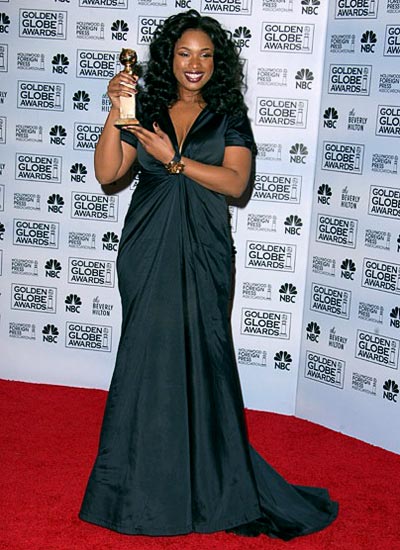
Oh, by the way, as expected our girl Jennifer Hudson took home the Award for Best Performance by an Actress In A Supporting Role in a Motion Picture. And I thought she looked great, too.
Also, Helen Mirren, one of my favorite actresses working today, picked up Best Actress awards for playing both Queen Elizabeth I and II. Love her. Can't wait till she gets an Oscar.
Saturday night I finally saw the movie of Dreamgirls. I saw it at the Ziegfeld Theatre here in New York where it premiered in December. The Ziegfeld is an old-time movie house encased in a monstrosity of a mid-1970s facade. But still, the lobby walls feature costume pieces and photographs from the Ziegfeld Follies, playbills of stars like Marilyn Miller and photographs of Flo Ziegfeld himself as well as original promotional artwork for movies like My Fair Lady. The auditorium is the size of a football field and a screen that size hasn't been seen since they closed the last drive-in movie theatre. Heavy velvet drapes adorn the walls and the whole place has that musty old theatre smell. It feels historic--and so does Dreamgirls.
The movie going experience at the Ziegfeld that night was unique not only for the history, but also for the crowd who was there which can only be described as GAY, GAY, GAY, GAY, GAY! And of course, Jennifer Hudson is our girl!
I expected that she would get an ovation after "And I'm Telling You, I'm Not Going" but she also got entrance applause, the way you applaud for a big star in a Broadway show during her first entrance of the show. The lines leading up Ms. Hudson's screen entrance are something like "Where's Effie, anyway." The camera swings around and lands on Jennifer who says something like "I'm right here." --THUNDEROUS applause from the audience. She not only got a hand after "And I'm Telling You..." which, to me, is truly one of the most powerful moments in the history of movie musicals, but she got applause after every one of her big solos. During the end credits of the film they name the cast members along with a little film montage of each. This audience could not wait for Hudson, who was last, to be named. The music slows down to a dramatic tempo and the words "and introducing" appear across the screen. Already the audience was hooting and hollering. But when the words "Ms. Jennifer Hudson" appeared an eruption of cheering and applause took over the theatre. The queens went wild! Except for Scott who refuses to applaud at movies.
Anyway, the movie is truly spectacular. There was not a single missed opportunity in the film. It's one of those movies that if you have to go to the bathroom, you will be hard pressed to try to find a lull in the action so you can go pee. Don't order the super-size soda and make sure you go before the movie starts. It's that good.
The blogosphere has been buzzing about Jennifer Hudson's stand-out performance in Dreamgirls ever since the film's premiere earlier this week. It has been reported that her performance of the showstopping "And I'm Telling You I'm not Going" received a standing ovation mid-screening at the Ziegfeld Theatre here in New York the other night. This has had everyone from Rosie O'Donnell to Michael Musto predicting an Oscar in Hudson's future. Certainly with endorsements like that and her image gracing the covers of both HX and Advocate magazine, her status as a gay icon is in the bag.
Or is it?
You may have read bits and pieces ofan interviewwith snarky gay Dallas reporter, Daniel Kusner, in which he clearly baits Hudson, questioning her Christian past. Hudson admits to getting her start singing "for church conventions." He then goes on to congratulate himself on his reporting skills saying "I had a hunch that Hudson was religious."
Gimme a break! This is newsworthy? Find me an African-American singing diva who DIDN'T get her start in church. Gospel music is well respected cultural tradition which has proven an excellent training ground for singers from Aretha Franklin to Fantasia Barrino.
Kusner pushes a gay-hating litmus test throughout the interview prompting an off-guard Hudson to respond at one point "No one has ever asked me these questions." He then goes on to quote her out of context saying "according to the way we're taught and what it says in the Bible--it (homosexuality) is (a sin)."
Now, I have a big problem with a small time reporter trying to make a name for himself by undermining the success of a 25 year old kid in her first big break since being prematurely voted off American Idol two years ago. I suppose Kusner was hoping to create the same kind of flap Kaizaad Kotwal did with his Carol Channing interview a few weeks ago. I am well aware of those who disagree with me, but I believe Kotwal stumbled upon Channing's anti-gay remarks innocently where clearly Kusner is going for the jugular with Hudson. Follow the link above and read his whole article if you don't believe me.
Baited or not, Kusner's interview created a mild firestorm among gaybloggers over the last couple of days which prompted a well timed statement from Hudsonin which she said among other things:
(The Bible) teaches us to love one another as God loves us all. I love my sister, my two best friends and my director dearly. They happen to be gay. So what? While some search for controversy, I hope that my friends and fans who know me, know where I stand."
So just calm down everyone and be nice! By the way, don't get me wrong, I adore Carol Channing, but you'll note that Hudson's statement stands in stark contrast to Channing's rather obtuse one following her little slip-up.
I realize all this seems like old news, but something has struck me ever sinceMandisa got the pink axafter her "lifestyle" remarks on last season's American Idol. What would make a venerable Broadway veteran like Channing scramble to save face with her gay fan base? What makes a diva-to-be like Hudson release a statement to the community she knows could catapult her to super-stardom? Why has Anita Bryant not had a professional gig since her stint as Florida orange juice spokeswoman in 1978?
It's simple. You just can't get away with this kind of thing anymore. Whether it's because of the changing political climate or our legendary impeccable taste and "disposable income," people care what we think. We matter. We have power. And that, my friends, is progress.
 Scott and I are making the rounds of seeing all the Oscar contenders for this year. Yesterday we saw Michael Clayton. So I've now seen four of the five films nominated for Best Picture. I still have yet to see There Will Be Blood, which Scott saw on his own with a friend, so he's one up on me. I'm looking forward to seeing Daniel Day Lewis' critically acclaimed performance, although I am not looking forward to sitting in a movie theatre for three hours. But that's a rant for another post.

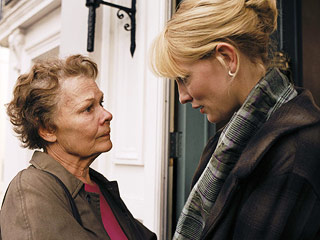 The other night I finally saw the movie people have been buzzing about for a couple of weeks now, Notes on a Scandal. It's beautifully acted and expertly told with an absolutely stunning Phillip Glass score by the way. But I couldn't help but be bothered by the perpetuation of the predatory evil lesbian stereotype in the the character of Barbara Covett, played by Judi Dench. Don't get me wrong, Dame Judi gives a stellar performance deserving of all the accolades she has received lately including her Oscar nomination. But I thought this kind of stereotypic role was a no-no these days. Has